
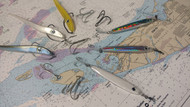
All About Hooks
Posted by Captain Tom Migdalski on 8th Mar 2021
Some anglers have difficulty understanding hooks鈥攕izing, terminology, and design鈥攂ecause there are so many variations on the market. Here鈥檚 a brief overview of an important subject to help you understand and catch more fish.
HOOK SIZES
The system of numbering hooks is counterintuitive. Small hooks range in sizes from 1-32, but they鈥檙e numbered 鈥渂ackwards,鈥� meaning, 鈥�32鈥� is smallest and 鈥�1鈥� is the largest. Medium to large hooks are labeled with an 鈥�0鈥� (pronounced 鈥渁ught鈥�) appearing after each number, such as 1/0, 2/0, 3/0, and up to 27/0. These progress in 鈥渃orrect鈥� numerical sizing, meaning, 鈥�1/0鈥� is the smallest and 鈥�27/0鈥� is the largest, with 1/0 being at the midpoint of the scale; thus, a size 6 hook is 10 times smaller than a size 6/0 hook. Sizes 20/0-27/0 are massive and intended for giant predators like tuna, swordfish and sharks. They can range in price from $20 to a staggering $210 each.
A hook鈥檚 shape determines its size, which causes hook dimensions to vary. The size of the hook is measured by a hook鈥檚 gap, which is the distance between the point and the shaft. Another key dimension is its throat or bite, which is the area between the point and hook bend. Hooks with larger dimensions in gap and throat create deeper penetration of the point and better holding power because the weight of the fish rides higher on the center of the hook鈥檚 bend.
Here鈥檚 a handy guide to fish species, hook types, sizes, and uses:

SUPER HOOKS AND STRENGTH
In recent years, newly-designed 鈥渟uper hooks鈥� have entered the tackle market. They鈥檙e produced by all the leading manufacturers, and these hooks are available in a great range of styles to meet the needs of every species with professional-grade construction and performance. Top anglers routinely change out the hooks that come 鈥渟tandard鈥� on their lures with super hooks.
鈥淢y go-to super hook preference,鈥� says Capt. Ned Kittredge, a pro out of southern Massachusetts with 30 years of chartering experience, 鈥渋s the Owner America brand. I prefer their ST-66 4X-strong tinned hooks as they are incredibly sharp right out of the package. I've lost many large fish because I didn't bother to swap out hooks. I have vivid memories of 40-plus-inch bass straightening the hooks on $12-$17 topwater plugs because, presumably, the manufacturer never 鈥榠ntended鈥� that lure to be used on big fish.
鈥淰MC trebles do a very good job for less money, and the slightly longer shank and thinner gauge wire performs well, especially for striped bass, bluefish, and false albacore. In fact, because of the weight difference, they have minimal impact on lure action. For the most powerful fish like tunas, however, it's the Owner ST-66 treble all the time, regardless of hook size.鈥�
With the introduction of high-tech coatings, ultra-sharp cutting points, innovative design, and extreme-strength ratings (like, 鈥�2X to 4X strong鈥�), they鈥檙e also more expensive than the old-time classics, the latter of which are still on the market. But for the additional cost of super hooks you鈥檒l almost instantly notice a difference.
鈥淭erminal tackle,鈥� says Rich Haigh, a saltwater expert from southwest Connecticut with 45 years of experience, 鈥渋s the single most important investment to catch fish, and it鈥檚 frequently ignored or overlooked. Anglers spend many thousands of dollars on boats, motors, rods, and electronics, only to shortcut their terminal tackle. Many hook manufacturers cater to the budget-minded and entry-level consumer by producing cheap hooks to lower costs and boost sales鈥攂oth for individual hooks and those rigged on lures. The low-quality hooks have lower tensile strength and less sharpness. That equates to reduced hook ups鈥攁nd worse鈥攈ook failure on big fish.鈥�
黑料吃瓜资源 lures excel because their hooks are high-grade right out of the package and never need changing out. This saves the angler time, money, and effort.
鈥淲e want our products to be ready to use on strong fish,鈥� says Dan Orefice, President of 黑料吃瓜资源, LLC, 鈥渁nd that鈥檚 why we selected quality components to match the EXO Jig. Paired with a 60-pound stainless steel split ring, we decided to use a 4X-strong VMC treble hook. We chose VMC, which has been producing fish hooks in France for over 100 years, because they have a great reputation and product. We singled out their 4X version because we wanted our EXO Jig to hold up to anything. We caught a 100-plus-pound shark in the Keys on the 1-ounce EXO Jig, and the hook held up perfectly.
鈥淔or the Big Occhi, we settled on a swimbait hook that had an extra-wide gap and is extra durable. The Big Occhi has a large body and we wanted to pair our soft plastic with a hook that could handle the bait. The Big Occhi works great when rigged weighted or weightless, so we鈥檙e now offering our Screw-In Swimbait hooks in both options. The 5/0 pairs well with the 7-inch Big Occhi, and the 7/0 pairs well with the 10-inch Big Occhi.鈥�

POINTS
Sharpness depends on the type of hook point and how it鈥檚 achieved in production. Some hooks have cutting-edge or spade-shape points, but all hooks have tradeoffs. Such a cutting point grabs quickly and penetrates tough jaws because the cutting edges slice though the toughest part of the mouth for a deep and solid hook set. The potential tradeoff is that the hook leaves a bigger hole in fleshier parts of the mouth, which could cause the hook to slide out during vigorous head shakes. However, they are precision-designed to create the smallest hole possible, so the incision can repair more quickly for released fish.
Conversely, conical tip or needle-point hooks create smaller holes, and in some cases may hold better than cutting-point hooks. So, you may opt for cutting points for rugged jaws like those of blackfish and bluefish but needle points for soft mouths like fluke or weakfish.
You can reasonably determine how sharp a hook is by placing the point on your thumbnail and pulling it across. If it slides on your nail, it鈥檚 not sharp. The more the point grabs or 鈥渂ites鈥� the sharper it is. Super-sharp hooks can very easily penetrate a finger or hand with little pressure, so use extreme caution when unhooking strong or feisty fish.
HOOK TYPES
The market is saturated with hundreds of variations of hooks. Just the shape alone can vary widely with different types of curves, bends, shank length, point lengths, and eye positions. Here is a snapshot of some of the most popular hook types.
Barbed or Barbless
Most fishing hooks have a barb, but some are available barbless (or you can easily crush the barb with pliers), often available in the same style and size as barbed and denoted 鈥淏L.鈥� A barbless hook is more fish-friendly, and hook removal is less stressful on the fish and the angler. They鈥檙e also extremely beneficial if the angler hooks himself (or someone else) because it means self-removal rather than surgical removal. Of course, it鈥檚 also easier to lose fish during a fight with a barbless hook, especially for novices.
Treble
Treble hooks consist of 3 hooks stemming from a single shank. Trebles are primarily used with diamond-style vertical jigs and casting lures like the 黑料吃瓜资源 Exo Jig, along with most casting plugs and jerkbaits. Trebles grab and hold fish better than single hooks, but they are therefore more difficult to unhook. When deep jigging, they also snag bottom more easily. Use extreme caution (for personal safety) when handling a fish caught on a lure featuring multiple trebles, as it鈥檚 easy for a flopping fish to stick you with a free-swinging hook.
Baitholder
Baitholder hooks are specially designed for holding bait such as seaworms, shrimp, squid, and baitfish chunks. This hook usually features a long shank, a down-turned eye (for snelling), and a chemically-sharpened point to effortlessly skewer bait. They often have two or three reverse barbs on the rear of the shank to help hold soft baits in place higher on the hook.
Jig Hook
Jig hooks typically have a 90-degree bend, a round offset eye, and a razor-sharp point with a barb. They鈥檙e available in various styles like wide-gap jig, weedless, flipping, heavy wire, and light wire. They鈥檙e equally popular in fresh and salt water applications. The jig usually consists of a colorful lead head with the hook molded into it, and the hook shank is usually covered by body material like a skirt, bucktail, or soft plastic.
Circle
Circle hooks feature a point with a pronounced curve inward toward the shank. They鈥檙e designed to slide out of a fish鈥檚 throat, roll, and grab in the corner of the mouth, which is popular鈥攁nd sometimes required鈥攊n catch-and-release fishing. Anglers must set circle hooks gradually to prevent them from sliding out a fish鈥檚 mouth before they can lodge in the jaw. Typical hook-setting advice is to just continue reeling without setting back hard with the rod as one would normally do.
Octopus
Octopus hooks look like a modified circle hook. They鈥檙e available in both traditional and circle hook styles. Primary distinguishing differences from a circle hook are the eye of an octopus hook bends backward, and the hook has a more tapered and narrow point. Octopus hooks are used primarily for baitfishing when minimal hook weight and size are essential for a natural presentation.
Like circle hooks, they鈥檙e sometimes difficult to unhook from a fish due to a short shank to hold onto. Owner and Gamakatsu make particularly super-sharp circle hooks.
J Hook
A J hook is the most versatile, classic, and common hook style; and it鈥檚 shaped like its name. You can use J hooks in almost any fishing application, and the long shank allows for easier unhooking because there鈥檚 more available leverage. The quintessential J hook is an O'Shaughnessy. Siwash are popular J hooks for bait and lures, too, but feature a longer point with a shorter shank.
Bottom Line
Your best bet for hook selection is to educate yourself by visiting a well-stocked tackle shop to study various hook configurations, sizes, and designs as they match to your target species. But know that the extra money is worth the hook-setting and holding ability of high-quality hooks, whether you鈥檙e bait or lure fishing.